1How a BNPL Payment Overdraws Your Account
Buy now, pay later plans are sold as interest free, and many are. But each plan takes its payments automatically, on fixed dates, from the debit card or bank account you picked at checkout. The payment goes out on the due date whether or not your paycheck has landed.
If your balance is too low that day, your bank decides what happens next. It may pay the installment anyway and charge you an overdraft fee, or it may decline it. As an October 2, 2026 article syndicated on AOL put it, a purchase can avoid interest and still end up costing you fees.
This is not rare. In a Federal Reserve report published in August 2026, based on its 2025 household survey, 11% of BNPL users said a BNPL payment had triggered an overdraft or non-sufficient funds (NSF) fee. The share was much higher for people with little cash set aside.
| Emergency savings | BNPL users who got an overdraft or NSF fee |
|---|---|
| Less than $100 | 18% |
| $100 to $499 | 13% |
| $500 to $999 | 6% |
| $1,000 to $1,999 | 6% |
| $2,000 or more | 4% |
| All BNPL users | 11% |
Source: Federal Reserve, Consumer and Community Context, August 2026, using the 2025 Survey of Household Economics and Decisionmaking. Savings means the largest emergency expense a person could cover with savings alone.
The risk grows when you have several plans running. We covered how BNPL plans pile up across apps in why buy now, pay later is quietly becoming another autopay problem. This guide is about the next step: what happens at your bank when one of those payments arrives on a bad day.
Among BNPL users with less than $100 in emergency savings, nearly 1 in 5 said a BNPL payment had triggered an overdraft or NSF fee.
2#1: How One Payment Can Cost Two Fees
When a BNPL installment meets a short balance, there are two companies involved, and each has its own rules. That is how one small payment can lead to two separate charges.
- If your bank pays it: you owe the bank the shortfall, plus an overdraft fee if your bank charges one
- If your bank declines it: your bank may charge a returned payment or NSF fee, if it still charges one
- Either way, if the BNPL company does not get paid on time, it may charge its own late fee under your plan terms
What happens after a failed payment also depends on the BNPL company. Afterpay's US payment terms say that if a bank account payment is declined, it will not try to collect that payment from the bank account again, and they warn that your bank may charge you for the failed payment. Klarna's help center says it will try again if it cannot collect a payment on the due date. If a company does retry, every new attempt on an empty account is another chance for a bank fee at banks that charge per item.
Note: retry rules and late fees change, and they can differ by plan type. Check the payment terms inside each BNPL app you use rather than relying on what a friend or a forum says.
If a payment does fail, our guide on what happens when an autopay payment gets declined walks through what to do in the first few days.
3#2: What Overdraft Fees Cost Right Now
Overdraft fees vary a lot from bank to bank. Bankrate's 2025 checking account study, published in September 2025, put the average overdraft fee at $26.77 and the average NSF fee at $16.82. FinanceBuzz noted in 2026 that many banks still charge around $35 per overdraft.
Some big banks charge far less, or nothing. According to Bankrate's tracking, Bank of America cut its overdraft fee to $10, while Capital One and Ally stopped charging overdraft fees altogether. Fees can also differ by account type, so the only number that matters is the one in your own bank's fee schedule.
Do not count on a federal cap either. The CFPB finalized a rule in late 2024 that would have limited overdraft fees at large banks, but Congress and the President overturned it in 2025 before it took effect.
Example scenario: a $25 installment hits two days before payday and your balance is $10. If your bank charges $35 for an overdraft, that one payment now costs you $60, before any late fee from the BNPL company. The interest free purchase is no longer free.
4#3: Line Up Installments With Payday
Most pay in 4 plans take the first payment at checkout and the rest every two weeks. Your paycheck may come every two weeks too, but rarely on the same days. Over a few cycles, an installment can land right before payday, in the same week as rent, a phone bill and a few subscriptions.
Example scenario: you buy a gift on Black Friday, November 27, 2026, with a pay in 4 plan. The remaining payments would fall around December 11, December 25 and January 8. If you are paid on the 15th and the last day of the month, the December 11 payment comes out when your balance is usually at its lowest.
- Write down your next three paydays and every bill or subscription that comes out between them.
- Open each BNPL app and add every remaining installment to that same list, with its date and amount.
- Look for any installment that lands in the last few days before payday, or in a week with a big bill like rent.
- For those, pay the installment early, right after your paycheck lands. Most BNPL apps let you pay early, and some let you change a due date in certain cases.
- Do this before the due date. Once the automatic payment has gone out, it is too late to move it.
5#4: Pay With a Credit Card, Not Debit
An overdraft can only happen on a checking account. If an installment is charged to a credit card instead, it does not touch your checking balance, so it cannot overdraw it. The amount simply goes on your card bill.
This only helps if you pay the card in full each month. If you carry a balance, card interest can cost more than the fee you were trying to avoid, and the purchase stops being interest free in practice. It also has limits: not every BNPL app or plan accepts credit cards, and some card companies block BNPL payments on their cards.
If you do switch, change the payment method inside the BNPL app for each open plan, not only for new ones. Our guide on debit or credit card for autopay covers the full trade off, including fraud protection and what happens when a card is replaced.
6#5: Change How Your Bank Handles a Short Balance
Under federal rules, your bank needs your permission before it can charge an overdraft fee on an ATM withdrawal or a one-time debit card purchase. If you never opted in, those are simply declined.
Recurring payments are different. Automatic debit card payments and bank transfers, which is how most BNPL installments come out, are not covered by that opt-in rule. Your bank may pay them into overdraft and charge a fee even if you never said yes to overdraft coverage.
- Ask your bank how it handles recurring and automatic payments when your balance is short, and whether you can have them declined instead
- Ask whether it charges a fee for a declined or returned payment, since many large banks have dropped that fee but not all
- Set up a low balance alert so you know before a payment date, not after
- Ask about linking a savings account to cover shortfalls, and whether the bank charges for each transfer
Having a payment declined is not free either, since the BNPL company may still charge a late fee. But a late fee is often smaller than an overdraft fee, and a decline does not push your account below zero.
Note: a stop payment order can block a charge at your bank, but it does not cancel what you owe on a BNPL plan. Use it for charges you did not agree to, not as a way to skip an installment. If money is tight, contact the BNPL company before the due date and ask what options it offers.
7#6: A Holiday Checklist for Every Installment
Holiday shopping is when BNPL plans stack up fastest. A few small plans in late November can mean several automatic payments in December and January, on top of your usual bills. Before you start, and after each BNPL purchase, run through this list.
- Treat every BNPL plan as a recurring payment with an end date, and add each installment to your bill list the day you buy
- Check that no installment lands in the last few days before payday, and pay early if one does
- Use one payment method for all your plans so you know which account each installment hits
- Keep a small cushion in checking through January for the payments you forgot about
- Know your bank's overdraft and returned payment fees before the first installment is due
- Look at each BNPL app once a week in December, since new plans are easy to miss
- Mark the date each plan ends, so you know when that money is free again
The hard part is that each BNPL app only shows its own plans, and your bank only shows payments after they happen. Neither tells you that three installments and your phone bill all come out the week before payday.
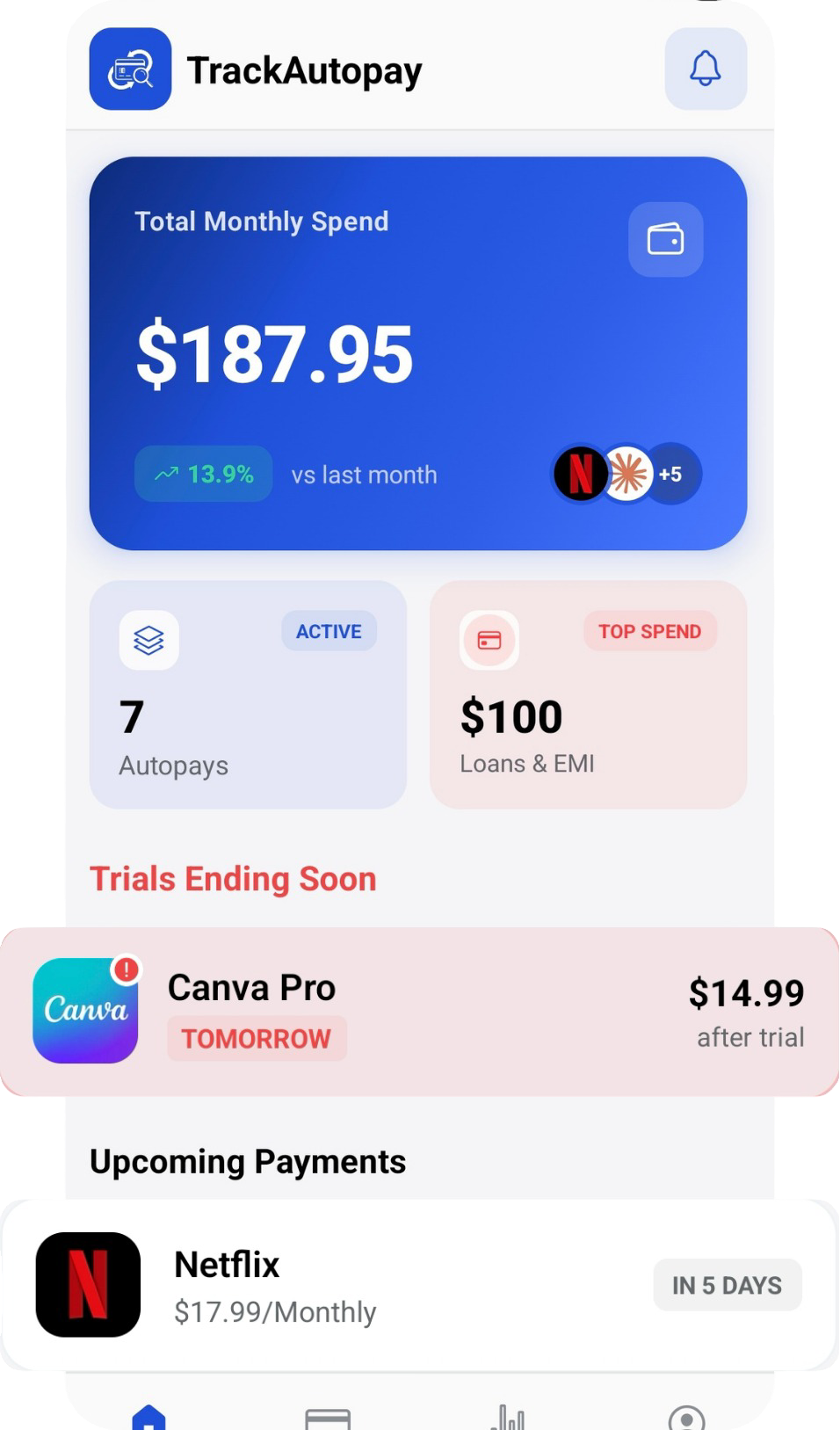
In TrackAutoPay, you can add each installment yourself with Manual Organization, next to your subscriptions and bills, so every payment sits on one calendar. Smart Tracking then reminds you before each one comes out, so you have time to pay early or move money before a short balance turns into a fee.
See Every Installment Before It Comes Out
Put your BNPL plans, bills and subscriptions on one calendar, with a reminder before each payment date.